Buying guide
Cable Machine Buying Guide (2027): Ratios, Travel, Stacks, and Room Math
How to buy a cable machine: translate pulley ratios into real handle weight, check cable travel and carriage range, choose selectorized or plate loaded, and measure the room honestly.
Translate the ratio before anything else
Take the printed stack weight and apply the ratio. At 1:2, halve it for one handle. At 1:1, the full load reaches your hand but travel shortens and the pull feels heavier and more direct. Write down your current cable row, press, and fly loads, halve or double them as the machine demands, and see whether the ceiling leaves years of headroom. This ten minute exercise prevents the most expensive mistake in the category: a trainer you outgrow in eighteen months.
Travel and carriage range are training specs
Cable travel decides whether a standing press finishes overhead or stops at your chin. Carriage range decides whether the pulley sits at ankle height for kickbacks and above head height for extensions. Check the lowest and highest pulley positions against your own height and your program, especially if you are notably tall or the machine is a compact model.
Top picks from our research
Full ranked list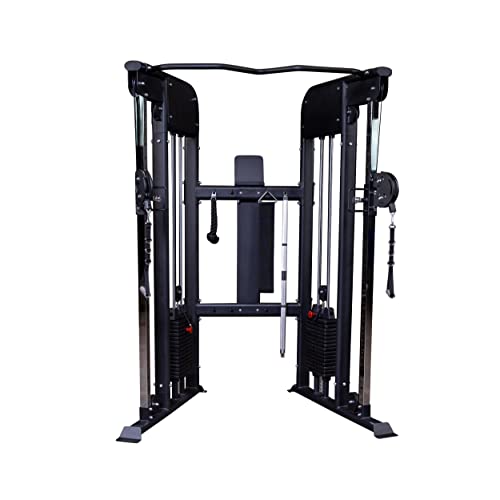
Selectorized versus plate loaded, honestly
Selectorized stacks cost more and change weight in a second, which protects supersets, circuits, and partner training. Plate loaded machines cost less and can pull heavier, but every change is a small plate handling session and your plate stock is shared with your barbell. Choose for the training you actually do at 6 pm on a tired Tuesday, not the training you admire.
Measure the room, the door, and the build
Record ceiling height at the lowest beam, wall width, and the doorway the parts must pass. Then add working space: roughly four feet in front of the pulleys. Wide crossovers fail more purchases on room math than on any product flaw, and assembly itself needs temporary floor space well beyond the finished footprint.
Attachments and the ecosystem
Every machine here uses standard carabiner attachments, so the aftermarket is shared. What differs is the starting kit. A trainer with handles, rope, and bars in the box can be the cheaper complete purchase even at a higher headline price. List the attachments your program uses weekly and price both machines complete, not bare.
FAQ
Questions, answered straight
What cable exercises justify a functional trainer over a single column?
Anything two sided and simultaneous: flies, dual cable rows, Pallof presses from either side without repositioning, and partner training. Single columns cover the one arm and two handed library at a fraction of the space and price.
How long do cables and pulleys last?
Under home use, years, with cables as the expected wear item. Inspect for fraying monthly, keep pulleys clean, and treat replacement cables as routine maintenance with parts available from the manufacturer.
Should a cable machine be my first big home gym purchase?
Usually after a rack, bench, and weights, because cables amplify a foundation rather than replace it. The exception is a lifter whose program is cable and dumbbell based by design, where a trainer like the GFT100 can anchor the room from the start.