In-depth review
Body-Solid GFT100 Review (2027): The Default Dual Stack Trainer, Examined
Full research review of the Body-Solid GFT100: stack system and upgrade path, pulley feel, carriage range, footprint, and ownership themes.
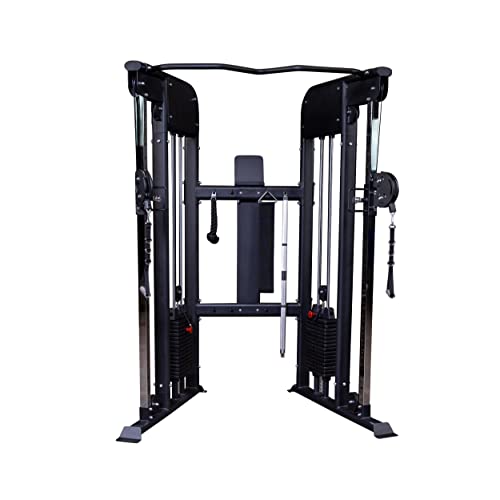
Body-Solid GFT100 Functional Trainer
Dual 160 lb stacks, a 1:2 ratio, and swivel pulleys on a frame built for daily home use.
- Two 160 lb stacks, upgradeable to 210 lb per side
- Weight stack
- 1:2 (handle weight is half the selected stack)
- Pulley ratio
- 45.1 x 64.5 x 83 in (W x L x H, manufacturer listing)
- Footprint
Our verdict
The GFT100 earns its default status by having no weak chapter. The stacks are deep enough for years of training and upgradeable when they are not, the swivel pulleys behave on awkward angles like low to high flies, and the frame has the overbuilt feel owners describe across Body-Solid machines. Its honest costs are the 1:2 ceiling that strong rowers will eventually meet, a footprint that claims a wall outright, and an assembly that should be scheduled like a project. For a home gym buying one cable machine to serve a decade, those are the right compromises.
What we like
- Two independent 160 lb stacks with a published upgrade path to 210 lb per side
- Swivel pulleys and tall carriages give a wide, natural arc on flies and presses
- Selectorized changes are instant, which keeps supersets and paired training moving
What to watch out for
- The 1:2 ratio halves handle weight, so strong lifters can top out the stack on rows
- Assembled footprint plus working space needs a dedicated wall, not a spare corner
Who it is for
Home gym owners building around one selectorized trainer for full body accessory work, pressing variations, and cable rows.
Stacks, ratio, and the upgrade logic
Two 160 lb stacks at 1:2 give 80 lb per handle, or double clipped together for heavy two handed patterns. The factory 210 lb upgrade is the detail that separates this machine from closed rivals: the day the stack runs out, the answer is a parts order, not a new trainer. Pin changes are instant and identical on both sides, which sounds minor until two people train together.
Carriage range and cable feel
The pulleys travel the height of the uprights and swivel to meet the line of pull, so the same station sets truly low for kickbacks and truly high for overhead work. Owner feedback on glide is consistently positive, with the reinforced nylon pulley design credited for staying quiet under load.
Footprint and room behavior
At roughly 45 by 65 in, the frame wants a wall and about four clear feet in front of it. Inside that box it is a complete cable gym. The machine does not fold, narrow, or apologize, so measure the room, the door it enters through, and the assembly space before ordering.
Ownership themes
Long term reports emphasize stability: cables and pulleys wearing predictably, stacks staying smooth, and Body-Solid parts support being reachable. Complaints cluster on assembly effort and on very tall users wanting more travel overhead, both knowable in advance.
Key specifications
- Weight stack
- Two 160 lb stacks, upgradeable to 210 lb per side
- Pulley ratio
- 1:2 (handle weight is half the selected stack)
- Footprint
- 45.1 x 64.5 x 83 in (W x L x H, manufacturer listing)
- Carriage
- Dual swivel pulleys, adjustable up and down each upright
- Frame
- 11 gauge steel main frame, fiberglass reinforced nylon pulleys
What owners report
Commonly praised
- Pulley glide stays smooth after the new machine period, according to long term owners
- Stack pins and carriages feel commercial rather than decorative
- One machine replaced several single purpose stations in garage setups
Common complaints
- Assembly is a long, two person job with many fasteners
- Cable travel on the tallest overhead work can feel short for very tall users
- The upgrade stacks are a meaningful second purchase
Recurring themes from owner reviews on retailers and forums, summarised by our editors. Updated October 2026.
Sources: Body-Solid GFT100 product documentation, Amazon listing specifications
Also consider
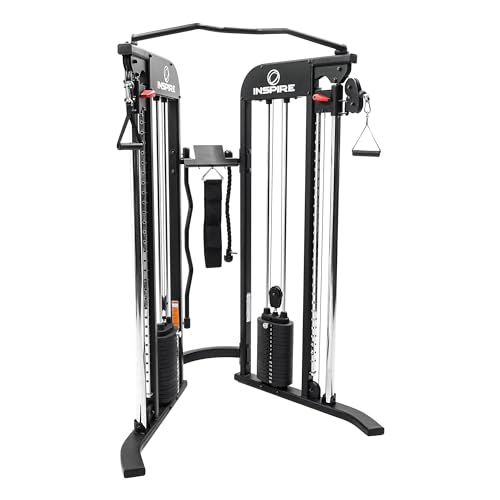 Inspire Fitness
 FTX Functional Trainer
A compact dual stack trainer with 165 lb stacks and an unusually complete accessory kit in the box.
- Weight stack: Two 165 lb stacks
- Pulley ratio: 1:2
Sources: Inspire Fitness FTX product documentation, Amazon listing specifications
Check price on Amazonor add to your Amazon cartChoose the FTX if your room is narrower than the GFT100 allows; it keeps dual stacks and adds a fuller accessory kit in a smaller frame. Read our Inspire Fitness FTX Functional Trainer review
REP Fitness REP FT-5000 2.0 Functional Trainer
The heavy stack option: deep weight per side, trolley carriages, and a choice of working heights.
- Weight stack: Two stacks, 224 lb per side in the current 2.0 configuration
- Pulley ratio: 1:2
Sources: REP FT-5000 2.0 product documentation, Amazon and manufacturer listing specifications
Check price on Amazonor add to your Amazon cartChoose the FT-5000 2.0 if you already know 160 to 210 lb stacks will not hold your rows; it starts where the GFT100 upgrade ends. Read our REP Fitness REP FT-5000 2.0 Functional Trainer review
Research-based assessment: manufacturer specifications and documentation, cross-checked against retailer listings and recurring themes in published owner feedback. We do not claim hands-on testing we have not performed.
FAQ
Questions, answered straight
Does the GFT100 need to be bolted down?
Most owners train on it free standing; the loaded frame is heavy and stable for cable work. Follow the manual for your flooring and use case, and keep heavy off axis pulls within sensible limits.
What attachments does it work with?
Any standard carabiner cable attachment: D handles, ropes, straight and curl bars, ankle straps. The swivel pulleys accept the whole standard ecosystem without adapters.
How hard is assembly, honestly?
Plan on several hours and a second person. The frame, two stacks, and cable routing reward patience and a sorted hardware layout. Owners who rush cable routing are the ones who redo it.