Head to head
Yes4All Wood vs BalanceFrom Foam Plyo Box (2027): Certainty or Forgiveness?
Wooden and foam 3-in-1 boxes compared on landing feel, missed-jump cost, floor behavior, and which households each material quietly serves better.

Yes4All 3-in-1 Wooden Plyo Box vs BalanceFrom 3-in-1 Foam Plyometric Box: the specs, side by side
| Spec | Yes4All 3-in-1 Wooden Plyo Box | BalanceFrom 3-in-1 Foam Plyometric Box |
|---|---|---|
| Heights | 30/24/20 in on the large size; 24/20/16, 20/18/16, and 16/14/12 in sizes also sold | 30/24/20 in on the large size; smaller sizes also sold |
| Construction | Plywood panels, puzzle-joint assembly with internal bracing | Foam core with durable cover, 3-in-1 flip design |
| Capacity | 450 lb per manufacturer listing | 350 lb class per manufacturer listing |
| Edges | Beveled top edges | - |
| Sold as | Single box, assembly required | Single box, no assembly |
| Surface | - | Non-slip textured cover |
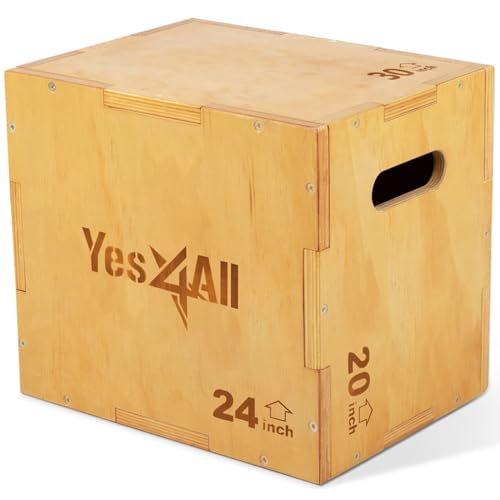 Yes4All
 3-in-1 Wooden Plyo Box
The standard wooden 3-in-1 in four size options, with beveled edges and a puzzle-joint build.
- Heights: 30/24/20 in on the large size; 24/20/16, 20/18/16, and 16/14/12 in sizes also sold
- Construction: Plywood panels, puzzle-joint assembly with internal bracing
Sources: Yes4All 3-in-1 wooden plyo box product documentation, Amazon listing specifications
Check price on Amazonor add to your Amazon cart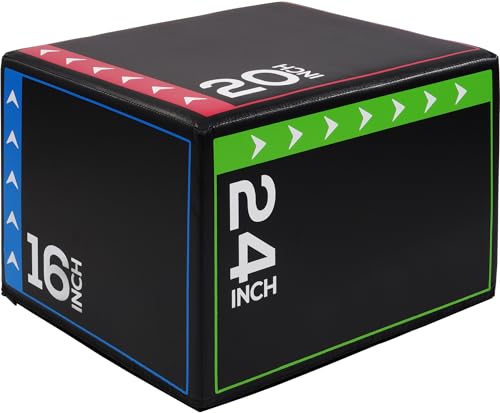 BalanceFrom
 3-in-1 Foam Plyometric Box
A foam 3-in-1 at the budget line: 30/24/20 heights without the wooden edge.
- Heights: 30/24/20 in on the large size; smaller sizes also sold
- Construction: Foam core with durable cover, 3-in-1 flip design
Sources: BalanceFrom 3-in-1 foam plyo box product documentation, Amazon listing specifications
Check price on Amazonor add to your Amazon cartOur recommendation
Buy the Yes4All wooden box if your jumps are trained, your landings are consistent, and you also want a platform for loaded step-ups and box squats. Buy the BalanceFrom foam box if anyone in the household is learning, returning, or simply unwilling to pay for a mistake with their shins. The materials are not better and worse; they price errors differently.
The missed jump
This is the comparison. A miss on wood meets a beveled plywood edge and produces the category's signature injury: painful, occasionally serious, always memorable. A miss on foam produces a stumble and laughter. Every other difference between these boxes is a footnote to how your household values that moment.
Landing certainty and heavy use
Wood gives a dead-solid, zero-compression landing that experienced jumpers trust at maximal effort, and it doubles as a load-bearing platform for heavy step work. Foam gives back a small compression on every landing and flexes under sustained loads. For jump training alone the gap is preference; for mixed platform duty it is decisive for wood.
Movement, storage, and floors
The foam box is light enough for anyone to carry and flip, and it is gentle on floors. That lightness also lets it shift on smooth concrete, so it wants a mat. The wooden box's weight is its stability and its inconvenience in equal measure, and it asks for the same mat to protect the floor beneath it.
Choose Yes4All 3-in-1 Wooden Plyo Box if…
- Your landings are consistent and jumps are a trained skill
- Loaded step-ups and box squats are in your weekly program
- You want the decade-long durability of a plywood structure
Choose BalanceFrom 3-in-1 Foam Plyometric Box if…
- Beginners, kids, or returning athletes share the box
- You train jumps for fitness, not for a standard
- The box will move rooms or travel to training partners
FAQ
Questions, answered straight
Can a foam box handle box jumps by a 220 lb athlete?
Within its 350 lb class rating, yes for standard training, with compression feel increasing with bodyweight. Athletes at that size who jump maximally several days a week are the wooden box's core users; occasional jumpers at that weight are well served by foam.
Which box is quieter in an apartment?
Foam, by a wide margin: landings and flips are both muffled. A wooden box on a hard floor announces every session to the floor below. Apartment trainers should also jump on matting regardless of box choice, for the neighbors and the joints alike.
Do I need different shoes for foam versus wood?
No. Ordinary training shoes suit both. The only footwear rule that matters is consistency: landings learned in one shoe behave slightly differently in a maximally cushioned runner, on either surface.