Buying guide
Plyo Box Buying Guide (2027): Material First, Heights Second, Assembly Always
How to buy a plyo box: choose wood, foam, or steel by your miss tolerance, map heights to the athletes in the house, respect capacity for loaded work, and budget the assembly hour.

Decide what a miss should cost
Every plyo box purchase is secretly an insurance decision. Wood charges the highest price for a missed jump and pays back the most certain landing in the category. Foam charges a stumble and pays back a small compression on every successful rep. Steel platforms sit with wood on both counts. Households with beginners, kids, or returning athletes should let the miss price lead. Experienced solo jumpers can honestly choose certainty. There is no toughness discount for choosing wood; there is only a risk profile.
Map heights to bodies, not ambitions
List the athletes, then the movements. Step-ups and box squats want a height near knee level for the user. Jump training wants a ladder: a starting height where landings are silent and identical, a working height, and a stretch height. The standard 30/24/20 serves average adults well and fails shorter athletes at both ends. Smaller 3-in-1 sizes and stackable sets exist because height is anthropometrics, not marketing.
Top picks from our research
Full ranked list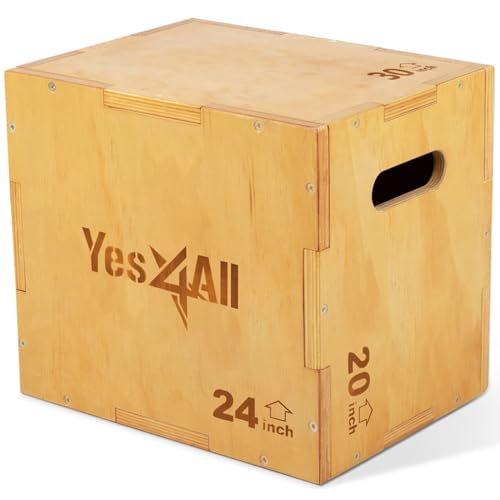
Capacity and the loaded-work question
Jump training loads a box dynamically, and loaded step-ups load it statically at bodyweight plus dumbbells. Read the rating against your heaviest combined use, and remember foam's rating describes jump training, not a platform for sustained heavy loads. Wooden boxes with published ratings in the 450 lb class cover nearly every home use honestly, provided the assembly was done completely.
Floors, weight, and the flip
Your floor is part of the product. Rubber matting under any box improves grip, silence, and floor survival, and light foam boxes effectively require it on smooth concrete. Then consider the box's own weight as a weekly experience: 3-in-1 boxes get flipped between heights constantly, and the big wooden sizes are a two-hand commitment. A box that is annoying to set up gets trained on less, which is the most expensive spec of all.
Assembly is a quality gate
Flat-pack wooden boxes transfer the final manufacturing step to you. Panels that fit precisely, hardware that is complete, and instructions that sequence correctly are what separate the guide's wooden picks from the category's complaint pile. Budget the hour, use a drill driver, tighten in sequence, and check the finished box for twist by rocking it on a flat floor before the first jump. A square box is a safe box.
FAQ
Questions, answered straight
What is the standard plyo box size?
The 30 by 24 by 20 in 3-in-1 is the CrossFit-era standard, presenting 20, 24, and 30 in heights from one footprint. It is a sensible default for average-height adults and a poor default for shorter athletes, who should look at the 24/20/16 class or a stackable set.
Can I build a plyo box instead of buying one?
Many home gyms do, from 3/4 in plywood with internal bracing, and a careful build matches budget commercial boxes. Price your time and materials honestly against the Yes4All class before starting; the commercial box's real product is often the saved weekend. Never jump on an unbraced single-wall box, whoever built it.
How long should a plyo box last?
A braced wooden box is a decade-plus structure under home use. Steel platforms are effectively permanent. Foam boxes age by their covers and foam resilience, on a multi-year horizon, with modular sets allowing single-block replacement. All three outlast most training programs when stored dry.