Fix it
Senior Treadmill Problems and Fixes: Slow Starts, Belt Drift, Stop Keys, and Dim Displays
Fix common senior treadmill issues: belt hesitation at low speed, drift, safety key faults, hard-to-read displays, and folding deck problems.

Most senior treadmill complaints trace back to four things: a dry or off-center belt, a safety key that is not seated, low-speed settings that need patience, or a display that needs its contrast, position, or lighting fixed. Work through these checks slowly, with the machine empty and at its lowest speed.
Belt hesitates or surges at 0.5 to 1.0 mph
Very low speeds expose a dry belt first. Lubricate under the belt center with the silicone specified in your manual, then run the empty belt at 1 mph for two minutes. If surging continues with a rider, check that the walk is not being done in thick socks on a worn belt, and book service rather than raising tension blindly.
Belt drifts toward one rail
Run the belt empty at 2 mph and adjust the rear roller bolt on the drift side a quarter turn at a time, waiting half a minute between turns. Never adjust while standing on the belt, and keep hands on a rail while testing the result at walking speed.
Machine will not start and the console beeps
Seat the magnetic safety key fully in its recess first; a half-seated key is the most common no-start on senior machines because the recess is below eye level. Then check the wall switch, the machine switch, and the circuit breaker, in that order.
Display is too dim or hard to read
Clean the lens, then adjust viewing angle and room light before assuming a fault: glare from a window behind the walker washes out most LCDs. If the model has a contrast setting, raise it two steps and retest from your walking position, not from beside the machine.
Folding deck will not lower gently
Clear the floor area, support the deck with both hands despite any soft-drop claim, and check the hydraulic strut for leaks or a bent bracket. A deck that drops fast is a service call, not a technique problem, especially in a senior household.
Handrail or adjustable rail feels loose
Stop using the rail for support until its bolts are checked. Tighten rail and console bolts evenly with the supplied wrench, then load the rail gradually while standing on the floor beside the machine. Recheck weekly on adjustable models like the UMAY; moving joints loosen faster than fixed ones.
Still stuck? Compare the current top picks
Full ranked list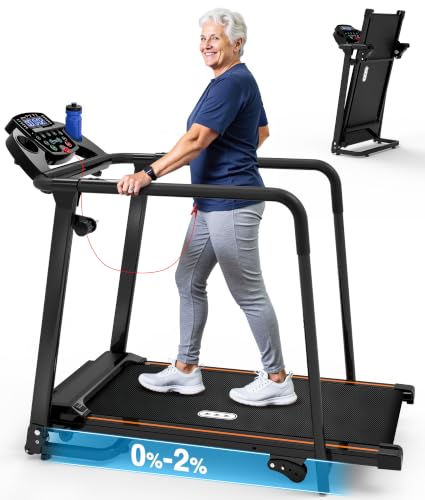
FAQ
Questions, answered straight
How often should the belt be lubricated?
Follow your manual, typically every three to six months at daily walking use. Write the date on a card kept with the lubricant; at low speeds a dry belt announces itself as hesitation long before it makes noise.
The safety key cord feels too short. Can I skip the clip?
Do not skip it. The clip is what stops the belt if you step back or slip. If the cord position fights your rail grip, reroute it per the manual or ask the maker for guidance rather than walking unclipped.