Cardio-inclusive focus: the failure mode is a treadmill consuming the load budget. This guide funds strength first, then adds the folding pad and interval tools that cover conditioning honestly.
Best Home Gym Under $1000 With Cardio (2027): Conditioning That Does Not Eat the Strength Budget
A $1000 build balanced for lifters who refuse to skip conditioning: walking volume, kettlebell intervals, and the sequencing that keeps strength funded first.
Our top picks at a glance
KingSmith WalkingPad A1 Pro Folding Treadmill
Conditioning and desk steps inside the compact path, where a rower or bike would break the space math.
BowFlex SelectTech 840 Kettlebell
Swings, goblet squats, and carries without a bell collection eating either path's storage.
BowFlex SelectTech 552 Adjustable Dumbbell
Anchor of the compact path: fast changes for circuits and shared households inside the total.
The short answer
Cardio inside $1000 works when it is a folding walking pad for volume and a kettlebell for intensity, bought after the dumbbell core is funded. What never works at this total is a running treadmill: it consumes the strength budget, the room, and usually its own owner's interest by spring. Steps daily, swings twice a week, and lifting circuits cover the conditioning map completely.
The picks, ranked
| Pick | Path role | Footprint | Stored size | Weight range | Price |
|---|---|---|---|---|---|
| KingSmith WalkingPad A1 Pro Folding TreadmillThe Volume Engine | Compact path cardio; the rack path usually conditions with the barbell and bells first | - | - | - | Check price |
| BowFlex SelectTech 840 KettlebellThe Interval Tool | Shared piece; hinge and conditioning for compact, accessory work for rack | About 7 x 7 in at the base, under 13 in tall | - | 8, 12, 20, 25, 35, and 40 lb settings | Check price |
| BowFlex SelectTech 552 Adjustable DumbbellThe Strength Core | Compact path core; replaces the cage, bar, and plates line of the rack path | - | - | 5-52.5 lb per dumbbell, 15 settings | Check price |
| TRX All-In-One Suspension Trainer SystemThe Circuit Station | Shared piece; second pulling angle and core station for both builds | - | Mesh pouch roughly 9 x 7 in | - | Check price |
The Volume Engine
KingSmith WalkingPad A1 Pro Folding Treadmill
The compact path's cardio: daily steps from a deck that folds in half and stores flat.
- 0.5-3.75 mph, walking only
- Speed range
- About 56.9 x 21.4 x 5.1 in unfolded
- Footprint in use
- Folds in half to a flat panel about 5-6 in thick for wall or under-bed storage
- Folded size
Strengths
- Folds in half, so cardio costs a wall lean or an under-bed slot instead of a room corner
- Walking pace work accumulates real conditioning volume during calls and desk hours
- Quiet, low deck suits shared rooms and upper floors that reject impact cardio
Limitations
- 3.75 mph ceiling and no incline define a walking tool, not a runner's treadmill
- Belt centering is a recurring small chore, as with every walking pad
| Speed range | 0.5-3.75 mph, walking only |
|---|---|
| Footprint in use | About 56.9 x 21.4 x 5.1 in unfolded |
| Folded size | Folds in half to a flat panel about 5-6 in thick for wall or under-bed storage |
| Belt size | About 47 x 16.5 in walking surface |
| Path role | Compact path cardio; the rack path usually conditions with the barbell and bells first |
What owners report
Commonly praised
- Step counts rise because the machine is reachable, the praise pattern across owner reports
- Folded storage is repeatedly named as the reason it survived small homes
- Remote and app control make workday walking genuinely usable
Common complaints
- Heavier than expected when stairs are involved in a move
- Long top-speed sessions warm the motor; duty guidance in the manual matters
- Long strides feel the belt's walking dimensions at top pace
Recurring themes from owner reviews on retailers and forums, summarised by our editors. Updated October 2026.
Sources: KingSmith WalkingPad A1 Pro product documentation, Amazon listing specifications
Best for: Conditioning and desk steps inside the compact path, where a rower or bike would break the space math.
Skip if: You run. This is a walking machine, and the rack path's conditioning answer is different anyway.
BowFlexThe Interval Tool
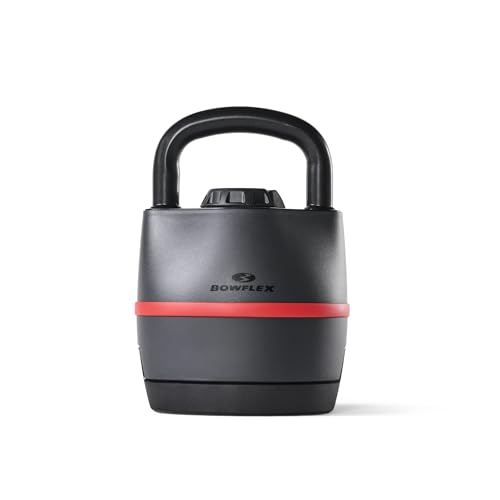
BowFlex SelectTech 840 Kettlebell
The shared hinge piece: six kettlebell weights in one shell for both paths' swing and goblet work.
- 8, 12, 20, 25, 35, and 40 lb settings
- Weight range
- About 7 x 7 in at the base, under 13 in tall
- Footprint
- Dial selector with internal plate stack
- Mechanism
Strengths
- Six weights from 8 to 40 lb replace a shelf of fixed bells in one footprint
- Dial selection is fast enough for swing intervals and supersets
- Wide handle window fits two-handed grips comfortably across hand sizes
Limitations
- 40 lb ceiling is a starting line for strong hinge training, not an endpoint
- Shell feel differs from cast iron on cleans and snatches
| Weight range | 8, 12, 20, 25, 35, and 40 lb settings |
|---|---|
| Footprint | About 7 x 7 in at the base, under 13 in tall |
| Mechanism | Dial selector with internal plate stack |
| Path role | Shared piece; hinge and conditioning for compact, accessory work for rack |
What owners report
Commonly praised
- Storage math is the praise: one slot, six bells
- Dial mechanism holds up indoors across long ownership
- Handle comfort on two-handed work is cited constantly
Common complaints
- Soft internal sounds at some settings distract purists
- One bell only; double bell work needs the second purchase nobody budgets
- Price invites comparison with two fixed bells wherever space is free
Recurring themes from owner reviews on retailers and forums, summarised by our editors. Updated October 2026.
Sources: BowFlex SelectTech 840 product documentation, Amazon listing specifications
Best for: Swings, goblet squats, and carries without a bell collection eating either path's storage.
Skip if: Your hinge training already swings past 40 lb, where the rack path's barbell takes over anyway.
BowFlexThe Strength Core
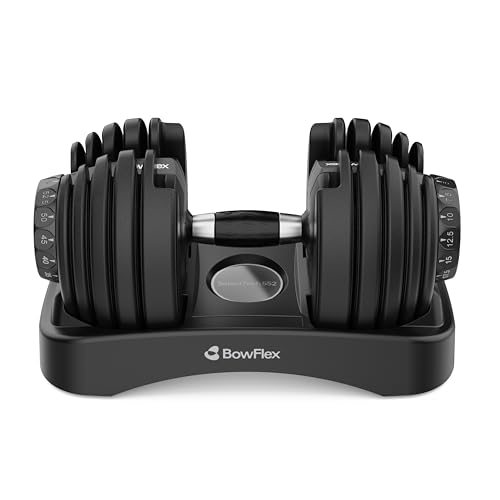
BowFlex SelectTech 552 Adjustable Dumbbell
The compact path's core: dial changes, 2.5 lb low steps, and a 52.5 lb ceiling per hand.
- 5-52.5 lb per dumbbell, 15 settings
- Weight range
- 2.5 lb steps from 5 to 25 lb, then 5 lb steps
- Increments
- 16.9 x 8.3 x 9 in per dumbbell in its tray
- Tray footprint
Strengths
- Dial changes in seconds make follow-along and circuit training possible, the $500 build's clearest missing feature
- 2.5 lb steps from 5 to 25 lb are the finest progression in either path at this total
- Trays keep the system compact enough for a spare room corner rather than a bay
Limitations
- 52.5 lb ceiling is final; there is no expansion inside the SelectTech dumbbell line
- Plastic dial housing demands controlled set-downs and dry indoor storage
| Weight range | 5-52.5 lb per dumbbell, 15 settings |
|---|---|
| Increments | 2.5 lb steps from 5 to 25 lb, then 5 lb steps |
| Tray footprint | 16.9 x 8.3 x 9 in per dumbbell in its tray |
| Mechanism | Dial at each end, storage tray required for changes |
| Path role | Compact path core; replaces the cage, bar, and plates line of the rack path |
What owners report
Commonly praised
- Change speed transforms session quality according to owners upgrading from spinlocks
- Second users in the household need no teaching, which shared gyms feel daily
- Low-end increments make small-muscle progression honest again
Common complaints
- Ceiling arrives first on rows and goblet work for stronger lifters
- Length on close presses is the standing feel complaint
- Single versus pair listing confusion persists; check the unit count before ordering
Recurring themes from owner reviews on retailers and forums, summarised by our editors. Updated October 2026.
Sources: BowFlex SelectTech 552 product documentation, Amazon listing specifications
Best for: Anchor of the compact path: fast changes for circuits and shared households inside the total.
Skip if: Your plan is barbell squats and bench at real loads; that is the rack path, and this budget must choose.
The Circuit Station
TRX All-In-One Suspension Trainer System
The shared pulling and core piece: a door-anchored station that stores in a pouch on both paths.
- Door anchor included; suspension anchor for beams and sturdy fixtures
- Anchor options
- A clear lane about 6-8 ft in front of the anchor
- Footprint in use
- Mesh pouch roughly 9 x 7 in
- Stored size
Strengths
- Adds a full pulling station to the compact path, whose dumbbell rows benefit from a second angle
- On the rack path it covers the high-rep and joint-friendly work barbells program poorly
- Pouch storage means it never competes with either path's footprint math
Limitations
- Load caps at bodyweight scaled by angle; it complements load, never replaces it
- Door setup discipline is required every session, without exception
| Anchor options | Door anchor included; suspension anchor for beams and sturdy fixtures |
|---|---|
| Footprint in use | A clear lane about 6-8 ft in front of the anchor |
| Stored size | Mesh pouch roughly 9 x 7 in |
| Path role | Shared piece; second pulling angle and core station for both builds |
What owners report
Commonly praised
- The gym that always fits, in owners' travel and home reports alike
- Strap quality holds across years of daily use
- Progression by angle keeps one tool honest for beginners and strong lifters together
Common complaints
- Handles rotate in the grip until technique settles
- Feet slide on slick floors at steep angles without the mat
- First week is setup learning, not training, for most owners
Recurring themes from owner reviews on retailers and forums, summarised by our editors. Updated October 2026.
Sources: TRX All-In-One product documentation, Amazon listing specifications
Best for: Rows, dips, and core work that add a station to either path for almost no space or budget share.
Skip if: No solid door or anchor point exists in your training room; this tool is its anchor.
FAQ
Questions, answered straight
Can walking really count as the cardio for a serious program?
For health and work capacity, daily walking volume is the highest-return conditioning most adults can add, and it never competes with lifting recovery. Intensity is covered separately by swings and circuits. Programs needing run-specific fitness should run, outdoors, and keep this build for strength.
What if I already own a bike or rower?
Then this build gets easier: drop the walking pad line, keep the strength core whole, and let the owned machine take the volume role. Budgets should never rebuy a working pattern, and the freed share belongs to the bench upgrade or the plate and dumbbell ceilings.
How do I split the week between lifting and conditioning here?
Walk daily at any hour, lift three or four days, and place swing intervals at the end of two lifting days rather than on their own day. That structure is what this equipment set was sequenced for, and adherence data in owner reports favors it over separate cardio days that quietly vanish.