Fix it
Battle Rope Problems and Fixes: Anchor Creep, Sleeve Bunching, Fraying, and Waves That Die
Fix the common battle rope problems: anchors that slide, sleeves that bunch, early fraying at the midpoint, handles that loosen, and waves that will not reach the anchor.
Battle ropes have almost no moving parts, so nearly every problem traces back to setup: the anchor, the surface, the length in your hands, or simple wave mechanics. Work through these fixes before assuming the rope itself is at fault. In most owner reports the rope was fine and the setup was lying to it.
Anchor slides or creeps during sets
The anchor point or strap is the issue, not your effort. Wrap the strap flat with no twists, position it low on the post or rack upright, and remove any slack before starting. On smooth posts, a rubber mat layer between strap and post adds grip. If the anchor object itself moves, it was never heavy or fixed enough; change the point rather than fighting it every session.
Waves die before reaching the anchor
Usually a technique and slack problem. Take a half step back until the rope just comes taut, start the wave from the shoulder and elbow rather than the wrist alone, and drive the rope down as actively as you lift it. If waves still die at full effort, the rope may be too long or too heavy for current conditioning; choke up slightly by holding a few extra inches of rope until strength catches up.
Protective sleeve bunches near the handles
Work the sleeve back along the rope by hand after sessions, distributing the material evenly from the middle outward. Bunching grows when a rope is always dragged from one end during setup. Coiling and uncoiling in large loops, rather than pulling the rope out of a pile, prevents most of it.
Fraying at the midpoint or along one section
Find the rough spot in your training area first; fraying maps to contact. Rotate the rope end for end monthly so the same section does not always sit at the anchor, keep sessions off sharp concrete edges, and treat early fuzz on an unsleeved rope as the signal to move to mats or turf before real fiber loss starts.
Handle caps feel loose or shift
Heat shrink caps can relax with heavy slam work and heat. Stop using a cap that rotates freely, since a shifting grip end changes hand position mid set. Replacement heat shrink and grip tape are standard hardware store fixes; seat any repair fully and let it cool or cure before the next session.
Rope feels far heavier than at the gym
Compare like for like before blaming fitness: gym ropes are often 30 or 40 feet, well broken in, and anchored on smooth floors. A new 50 foot sleeved rope at home is a genuinely heavier tool. Shorten intervals, choke up slightly, and let the rope break in over several sessions before judging the purchase.
Still stuck? Compare the current top picks
Full ranked list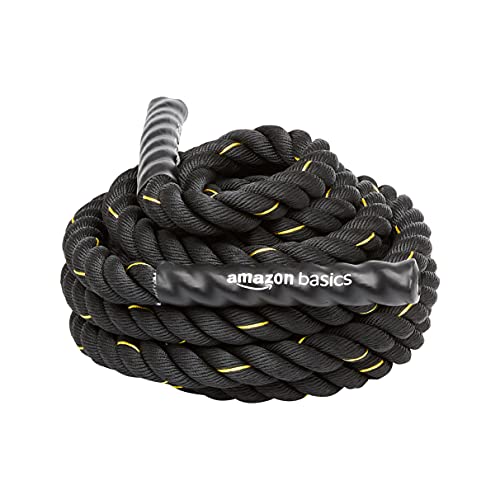
FAQ
Questions, answered straight
Can I wash a battle rope?
Synthetic ropes can be hosed down and air dried fully before storage, which suits driveway and yard ropes. Keep detergents mild, rinse well, and never store a rope damp in a closed bin, where mildew smell becomes the next problem.
My rope twists and tangles between sessions. Why?
One directional coiling winds twist into the rope over time. Alternate your coil direction, or use a figure eight coil on the floor, and shake the rope out fully at setup rather than pulling loops from the pile.
When is a rope worn out?
When fibers are cut through rather than fuzzed, when a handle cap cannot be secured, or when the midpoint section at the anchor shows deep wear. Surface fuzz alone is cosmetic on a working rope, especially under a sleeve that is designed to take that wear.