Buying guide
Training Sandbag Buying Guide (2027): Fillers, Shells, Handles, and the Sand You Supply
How to buy a training sandbag: filler bag systems, Cordura class fabrics, handle layouts, double shell leak protection, and realistic weight sizing.
Start with the truth: it ships empty
Every full size training sandbag ships empty, and sand is never included. What you are buying is a shell, a set of filler bags, and a handle layout. Your total cost and effort therefore includes a trip for play sand, a scale, and half an hour of filling. Any listing photo showing a plump, heavy looking bag is showing you the bag after that work is done. Budget for it, and the category makes sense; miss it, and your new bag sits in a corner for a month.
Filler bags are the product
The filler system decides weight steps, adjustment speed, and whether your floor stays clean. Good fillers close twice, with a fold or roll plus hook and loop, and are sized so two or three of them span the bag's useful range. Weigh each filler as you fill it and mark the weight on it. Fill to just under the line: an overfilled filler cannot seal, and an unsealed filler is a sand dispenser. If a bag's fillers are sold separately, add that cost before comparing prices.
Top picks from our research
Full ranked list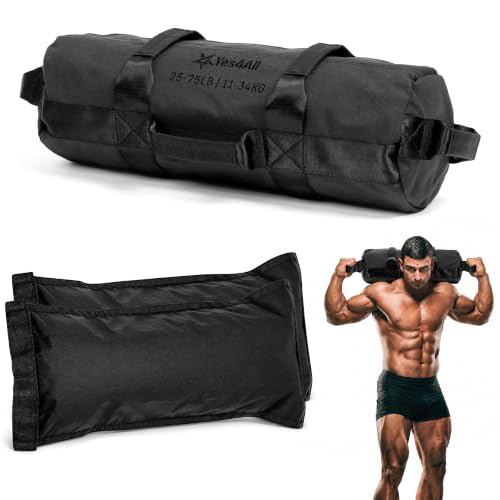
Shell fabric classes, in plain terms
At the top sit ballistic nylons in the 1000D Cordura class: heavy, abrasion resistant, and the right choice for drags, outdoor work, and daily volume. Mid tier synthetics handle indoor lifting and carries well and age faster under abrasion. Budget shells are for learning the movements at moderate weights. In every class, the stitching at the handle roots matters as much as the fabric, because that is the joint that carries the load.
Handles: count them, then place them
A big handle number means little if the positions are wrong. The useful set: neutral handles along the top for cleans and rows, a top center grip for carries and goblet work, and end handles for drags, swings, and partner passes. Smooth, well finished handles matter for high rep work; rough webbing edges are a small thing in a listing and a big thing in week three. The one exception in this guide, the SandBell, has no handles at all, by design, and trains grip directly.
Size the bag to your middle weight
Adjustable bags feel best in the top half of their filled range and sloppy at the bottom. Choose the size whose comfortable middle matches the weight you will use most, not the maximum you might touch twice a year. Remember that sandbag pounds punch above their number: a shifting 50 lb bag outworks a fixed 50 lb implement on almost every lift, so leave your barbell ego out of the size choice.
FAQ
Questions, answered straight
How much sand do I need to buy?
Match it to your bag's target fill with a little spare. A standard hardware store bag of play sand covers a medium training bag; big bags at full weight can need two. Keep the spare dry for topping up.
What is double shell leak protection?
It means two barriers between the sand and your floor: a sealed inner filler bag, and the closed outer shell around it. Bags that rely on a single layer and a zipper are the ones with dust in their complaint sections.
Can I wash a sandbag?
Empty it, brush it down, and wipe the shell with a damp cloth and mild soap. Do not machine wash a filled bag, and let everything dry fully before refilling, because damp sand clumps and weighs unevenly.