Buying guide
Resistance Loop Band Buying Guide (2027): Latex Versus Fabric, Ladders, Sizes, and Care
How to buy loop bands: choose material by movement, read the ladder instead of the labels, match band dimensions to placements, and treat light latex bands as the consumables they are.
Choose material by movement, not by trend
List the movements you will actually do. Ankle and wrist placements, shoulder external rotations, arm work, and mobility drills point to thin latex, because nothing else is narrow and light enough. Squats, hip thrusts, abductions, and lateral walks done weekly point to fabric, because stability and comfort dominate those sessions. Most real programs contain both lists, which is why this guide keeps recommending a latex set first and a fabric set when leg volume justifies it, rather than crowning one material for everyone.
Read the ladder, ignore the labels
There is no industry standard behind the words light, medium, or heavy for loop bands. Compare sets by structure: how many levels, how gentle the lightest feels by owner consensus, and how strong the heaviest is for your biggest movement. A set with a missing bottom rung fails rehab users; a set with a low ceiling fails strong glute training. The right ladder is the one whose ends match your weakest and strongest band jobs, with steps between that you can actually feel as progression.
Top picks from our research
Full ranked list
Dimensions decide placements
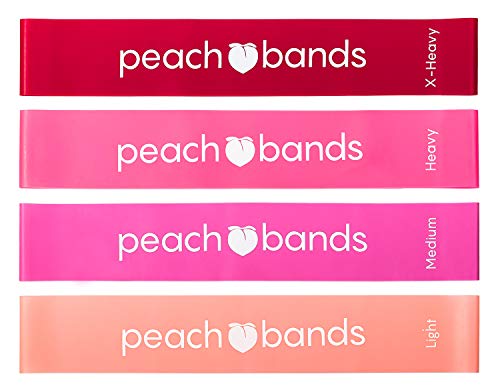
The standard mini loop is about 12 inches long laid in a loop and 2 inches wide, and that size is a compromise that reaches ankles, knees, wrists, and thighs adequately. Wider fabric bands, around 3 inches, own the thigh and forfeit the rest. Longer loops in clinical lines suit taller users and some mobility patterns. If a favorite movement needs a placement the band cannot comfortably make, the band is wrong for you whatever its resistance is.
Allergy, skin, and household realities
Latex allergy rules out latex sets completely for the allergic user, and in a shared household it argues for fabric and latex free options being the house sets. Bare skin training argues for fabric or a smoother finished latex. Households with children and pets should store bands closed away, since a snapped band and a curious pet are a poor mix, and bands under tension should never be aimed playfully at anyone.
Care, inspection, and the replacement habit
Before every use, stretch the band lightly and look for nicks, tears, and pale stress marks, especially on the lightest levels. Store bands in their bag away from heat, sun, and sharp gym hardware. Wipe latex down after sweaty sessions and let fabric bands air dry. Replace any band with a visible nick immediately; bands almost always snap at a nick, under load, at the worst moment of a rep, and the replacement cost of the lightest band in a set is the cheapest safety spend in a home gym.
FAQ
Questions, answered straight
How many loop bands should a home gym own?
One five level latex set covers a beginner completely. Add one three level fabric set when leg and glute work becomes a weekly fixture. Beyond that pair, extra sets are about second locations and partners, not new capability.
Do thicker bands always last longer?
Within a material, heavier levels usually outlast lighter ones because they are stretched less relative to their capacity. Across materials the comparison breaks down: fabric fails by stitching and elastic fatigue, latex by nicks and snaps.
Can loop bands replace weights for legs?
For activation, endurance, and beginner strength, they carry a program surprisingly far. For continued lower body strength and muscle progression, they become the accessory to loaded work rather than the replacement for it.