Buying guide
Dumbbell Rack Buying Guide (2027): Rail Length Math, Saddles, Capacity, and Casters
How to buy a dumbbell rack that actually fits your set: measure dumbbell widths, decode pair counts, choose saddle or flat rail, and size capacity with margin.
Do the rail length math first
Line up every pair you own, and every pair you realistically plan to buy in two years. Measure the width each pair needs on a rack, roughly its head width plus a finger of clearance. Add them up. That number, in inches, is your minimum total rail length across all tiers, and no advertised pair count can overrule it. Then buy the next size up, because dumbbell collections have never once shrunk.
Decode the advertised pair count
Pair counts in listings assume a set weighted toward small dumbbells with narrow heads. A 10 pair claim often means 5s through 25s, not 5s through 50s. Neither is a lie exactly, but only one matches a serious set. Judge every rack by its dimensions and capacity, and treat the pair count as a hint about the size class the maker had in mind.
Top picks from our research
Full ranked list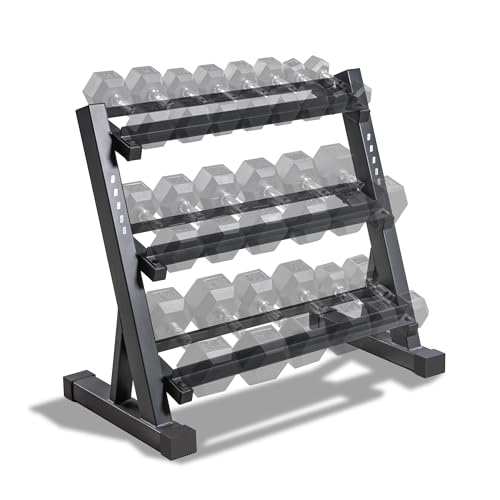
Saddles, cradles, and flat rails
Saddles are individual cradles that locate each dumbbell: tidy, quiet, roll proof, and ideal for round dumbbells, at a higher price and with fixed spacing. Flat rails hold anything anywhere along their length, suit hex dumbbells perfectly, and cost less, with round dumbbells asking for careful placement. A-frames use small cradles in a vertical frame and belong to light sets only. Match the rail to the dumbbells, and both will behave.
Capacity and tier strategy
Add up your set's total weight and demand a rating comfortably above it; a 5 to 50 lb ten pair set already exceeds 500 lb. Then load smart regardless of rating: heaviest pairs on the bottom tier, lightest up top, balanced side to side on A-frames. Angled tiers are worth having, because they turn reracking a 50 lb dumbbell from a deadlift into a slide.
Footprint, floors, and wheels
Measure the wall run including baseboards, and leave working room at one end. On carpet, plan a firm platform under the feet. Casters earn their keep only on smooth, flat floors, and they trade a little planted stability and effective capacity for movement, so choose them when the room genuinely rearranges, not as a default upgrade. Lock every wheel, every time the rack is parked.
FAQ
Questions, answered straight
What size rack does a 5 to 50 lb set need?
A full width 3 tier rack in the roughly 50 in class, with a capacity rating well above the set's 500 plus pounds. That is the Marcy and WF class in this guide.
Can I put a rack on the second floor?
People do, with the load spread on a platform and the rack against a load bearing wall. The rack plus set can exceed 600 lb in a small footprint, so if the floor's capacity is in any doubt, ask a professional before the dumbbells move in.
Is it worth paying for saddles?
For round dumbbells and lifters who rerack fast between sets, yes. For hex sets in a home gym, flat rails do the same job for less, and the savings buy another pair of dumbbells.