Buying guide
All-in-One Home Gym Buying Guide (2027): Formats, Resistance Ceilings, and Smith Bar Reality
How to buy an all-in-one home gym: choose the format that matches your training, translate resistance claims into ceilings, judge Smith bars by starting weight and stops, and measure working footprint.

Name your format honestly
Write down last month's actual training: how many sessions were barbell lifts, machine circuits, cable work, or low impact conditioning. The format that serves the majority of those sessions is your format, even if a different machine photographs better. Smith cages serve bar centric lifters, stack stations serve circuit trainers, rod and bodyweight systems serve space and joint constrained trainers. Every regret in owner feedback starts with buying a format for a training life the owner does not lead.
Translate resistance into a ceiling
For each format there is a hard top: the stack's total, the rod pack's maximum, the plates you own for a loaded system, a percentage of your bodyweight on an incline trainer. Compare that top with your strongest movement in the system, rows and presses usually, and require headroom for two years of progress. A system at its ceiling is not broken; it is finished, and replacing it is the upgrade path nobody budgets for.
Top picks from our research
Full ranked list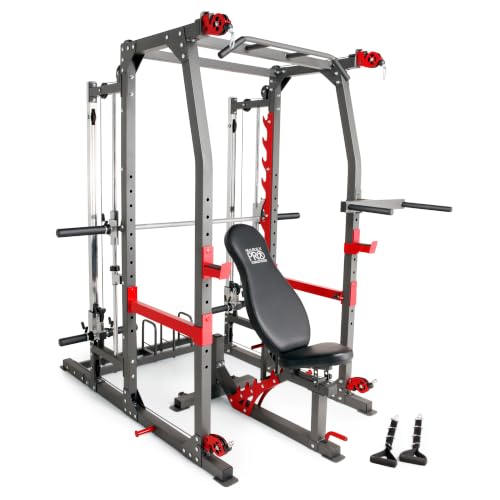
Judge the Smith bar like equipment, not a feature
Ask four questions. What is the starting weight, and is the bar counterbalanced? How do the safeties set, and can you set them alone in seconds? Is the path vertical or angled, and does that suit your squat and press? What is the rated bar capacity from the manual, not the frame's marketing total? A Smith bar you trust becomes a training partner for solo work; one with vague answers stays a storage rail.
Cables: source, travel, and pulley height
Stacks feel best and cost most; plate carriages feel adequate and cost least. Beyond source, check that pulleys reach high enough for lat work and low enough for rows without the carriage topping out mid rep for your height. Tall lifters should treat cable travel as a first order spec, because a pulldown you cannot fully extend is a station you will route around forever.
Measure the working footprint and the delivery
Add bench length, loading clearance, and walk around space to the frame dimensions, then check ceiling at the tallest station. Finally, walk the delivery path: door widths, turns, and stairs have ended more all-in-one plans than any spec sheet. Large systems arrive in many heavy boxes, and knowing where they will stage during a long assembly is part of the purchase.
FAQ
Questions, answered straight
Are exercise count claims meaningful?
Only loosely. Counts treat every variation as a new exercise. Judge instead by movement patterns covered: squat, hinge, press, row, vertical pull, and isolation work, and whether each is loaded adequately for you.
Do I still need a separate bench?
Smith cages and racks, yes: their pressing and rack work assume a bench, sometimes included in bundles and sometimes not. Stack stations and bodyweight systems build their seats in and need no bench.
What warranty signals matter?
Frame coverage length, and whether cables, pulleys, and upholstery, the wear layer, have defined terms and available parts. A strong frame warranty with no cable availability is half a promise.